"Recent Israeli Attacks 'Significantly Weakened' Syria’s Air-Defense Systems" by Robert Inkalesh
On the night of June 30 until the early morning of July 1,
2019, Israel carried out its biggest attack against Syria’s air defense since
1982. The attack ultimately killed 16 Syrian civilians near Damascus and
injured 12 Syrian military personnel in Homs. This was the extent of the damage
revealed at the time but, according to Syrian military sources, the damage was
much more severe and served to significantly weaken Syria’s air-defense
capabilities.
Many questions have gone unanswered about what truly
happened during that attack, how it happened, and what implications the attack
may have.
According to a Syrian Air Defense officer who writes
post-mission reports, and who spoke to MintPress on condition of anonymity
owing to security concerns, Israel delivered a brutal blow during the June 30
attacks, resulting in the lowering of Syria’s air defense capabilities by
roughly 60 percent. It is estimated that Israel fired upwards of 150 cruise
missiles at Syria’s early-warning air-defense systems, completely destroying at
least five of the targeted systems. All of the systems targeted were
specifically responsible for dealing with Israeli airstrikes and in total were
worth up to $500 million.
The attack was a violation of the sovereignty of Syrian
territory as well as a violation of the UN Charter of 1945, with the use of
force by states in this manner being considered illegal under customary
international law as well as by treaty law. But perhaps the most revealing
detail of the airstrikes is that they constitute the largest attack on Syrian
Air Defense since Operation Mole Cricket 19, on June 9, 1982, conducted by
Israel towards the end of the Lebanon-Israel war. It is also the largest single
attack by Israel on Syrian territory since the 1973 Yom Kippur War.
Israeli-U.S. coordination?
As it has demonstrated during the ongoing Syrian war, Syria
has built a reputation for its air-defense capabilities. Syrian air defenses
posed a considerable challenge for enemies of the embattled country, including
Israel, attempting to pull off successful attacks. While some missiles would
get through and hit their targets, Syria was able to deal with strikes
conducted against it by the U.S., U.K., France and Israel without sustaining
too much damage, many times deflecting the bulk of the incoming missiles. These
defense capabilities were further bolstered by the more recent addition of the
Russian S-300 air-defense systems to Syria’s arsenal. Syria was able to down
Israeli fighter jets and drones, and shoot down the majority of Israel’s
incoming missiles.
Israel had grown frustrated at Syria’s increasingly
effective air-defense capabilities and, with the latest spat of strikes, sought
to act on that frustration. It was reported in May of this year that Israel was
attempting to locate Syria’s air-defense systems, sending drones and even
balloons into Syrian airspace to identify potential targets.
It is also likely that the U.S. coordinated with Israel in
setting Syria up for such a bombardment. On the morning of June 30, before
Israel began its own airstrikes, the United States launched an unprecedented
strategic airstrike against two leaders of an Al Qaeda-linked militant group in
Western Aleppo, called Hurras al-Deen. The strike was highly unusual, as the
United States ordinarily strikes areas of Syria where there are no air defenses
and it is not a usual thing for it to target groups that control what is deemed
as the Idlib pocket. Prior to the execution, the U.S. reportedly communicated
with Russia to request Syrian forces to disable their GPS jamming equipment so
as not to interfere with the airstrike. The U.S. was able to kill six militants
and the Syrian government, assuming the U.S. was looking to launch more attacks
against militant groups, kept its GPS jamming equipment offline.
On that same day, specialists attached to a Lebanese
Hezbollah contingent were traveling back to Lebanon from Eastern Syria, where
they were partnered with Iraqi PMUs (Popular Mobilization Units) operating in
Abu Kamal. The movement of these groups, both arch-enemies of the Israeli
government, gave Syrian forces ample reason to believe that they could be
potential targets of an Israeli attack — which further contributed to Syria’s confusion.
Syria has dealt with strikes against Hezbollah on its soil many times prior to
this, so if they were preparing for a similar situation, this may have been a
distraction.
On June 11, Israel launched an attack on Syria’s Northern
Daraa province, destroying an early-warning radar on the Tal al-Harra hilltop
and depriving Syrian forces from monitoring the skies over the Golan Heights
and Northern Israel.
The combination of these factors left Syria’s vision
impaired, it’s GPS jamming systems down, justification for Israel to strike,
and Syria open to Israeli airstrikes and diversions.
Not the “normal” attack
When the Israeli onslaught finally came, it perhaps not
surprisingly rendered a bigger challenge for Syria’s air defenses than usual.
Syrian forces were not expecting such a large attack and, from the size of the
bombardment, is clear that Israel planned the operation in advance. The usual
Israeli attacks, of which there have been hundreds during the course of the
Syrian war, consisted of 60 missiles at most — Israel used in excess of 100
during this attack.
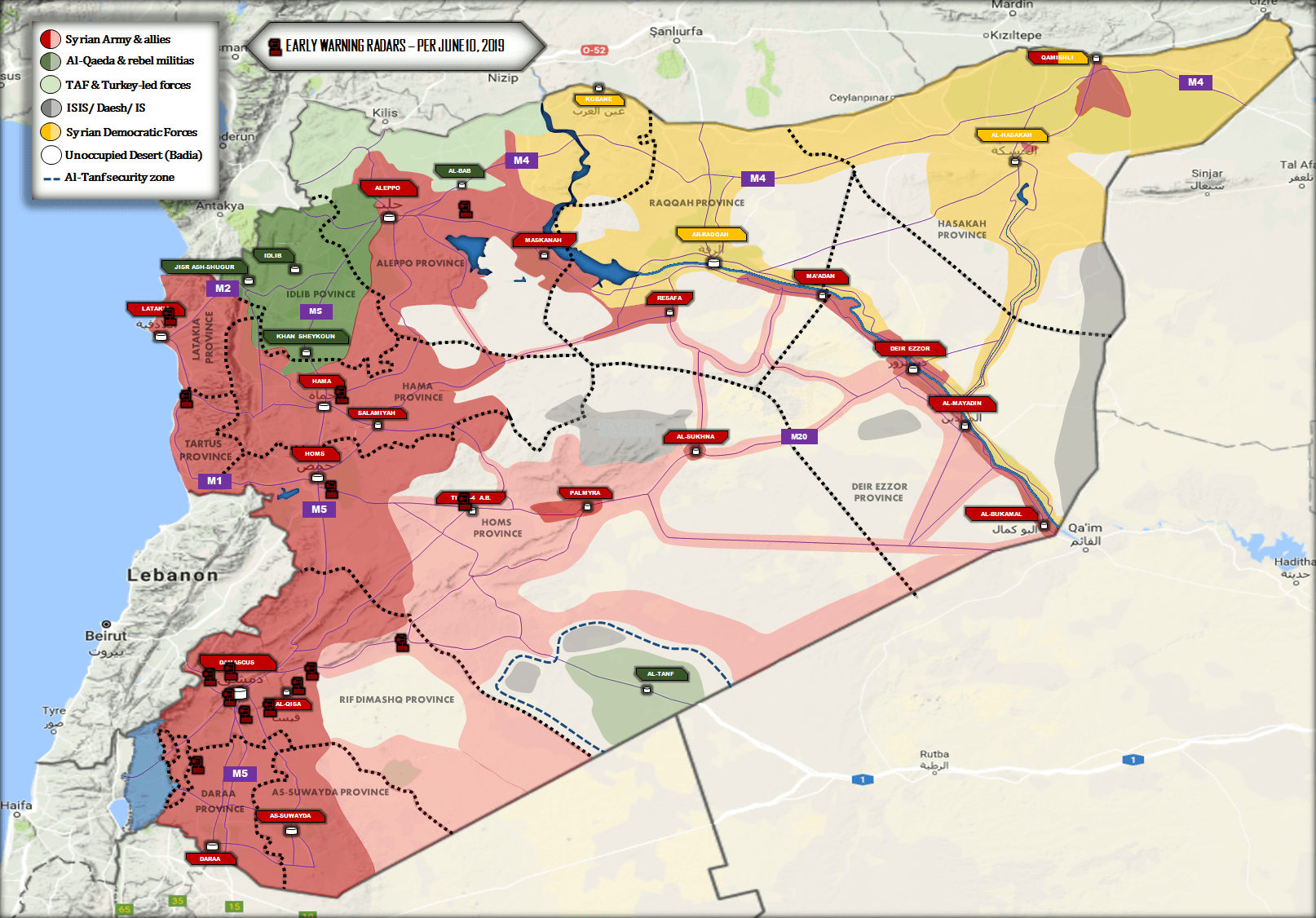
Map shows early warning radar positions, June 19, 2019. Andrew Illingworth | MintPress
Israel also attacked from three different locations: from Northern Lebanon into Homs; from the occupied Golan Heights into the Damascus region; and from the sea near Southern Lebanon into Damascus. It did so using Delilah as well as Popeye Turbo cruise missiles.
Several areas were reportedly struck in and around Damascus, including Al-Dimas, Jamraya, Mezzeh Airbase and Al-Kisweh/Jabal al-Mani. Three air-defense sites in Homs city and two in the al-Qusayr area, linked to a single radar, were also destroyed.
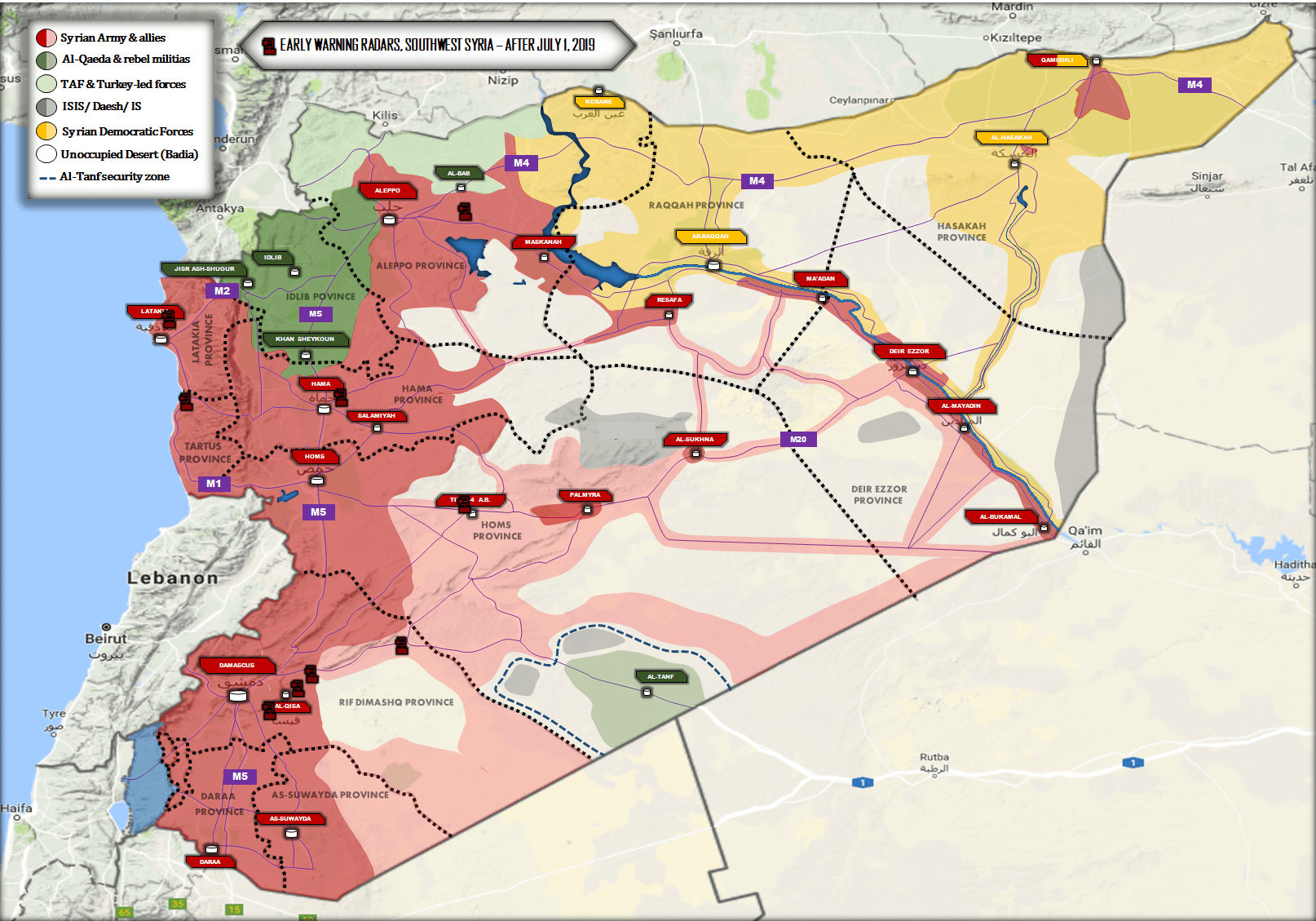
Map showing early warning radar sites after July 1, 2019. Andrew Illingworth | MintPress
Considering both the types of missiles used as well as the locations from which they were fired, it is likely that Israel used both F-15 and F-16 aircraft as well as a Navy vessel to deliver its deadly payload of cruise missiles.
The 36 D6 radars, which are part of the S-300 systems, were also reportedly targeted in this attack. However, Syrian military sources that spoke to MintPress claim that the S-300 was not used, maintaining that only more antiquated older S-200 systems were used and that the S-300 missiles weren’t used due to timing. That same S-200 system was what led to a Syrian missile landing on the Island of Cyprus last June when it went astray after attempting to down an Israeli jet.
The sheer scale of the Israeli attack left Syria so isolated that it was forced to focus primarily on defending its own surface-to-air missile (SAM) sites, leaving much of the rest of the country exposed, a fact Israel then exploited.
If the extent of the damage to Syria’s air defenses claimed by Syrian military sources is accurate, Syria is now left with only two minutes of warning prior to a potential Israeli attack — previously it had somewhere between 10 and 15. Unless Russia resupplies Syria with new equipment, this deficit will likely mean that future Israeli attacks will claim even more lives and reap even more destruction.
Israel refused to comment on the attacks and no explanation was given as to why it conducted them. While an attack of this scale on virtually any other sovereign nation would likely provoke a major response from the international community, this attack has barely registered.
Robert Inkalesh is a journalist, writer and Middle-East analyst.


Comments
Post a Comment