The Twelve Days of Technocracy Part 2
Day 7: China Is A Technocracy

Thanks to early members of the Trilateral Commission, China was brought out of its dark ages Communist dictatorship and onto the world stage. Furthermore, the Trilateral Commission orchestrated and then facilitated a massive transfer of technology to China in order to build up its non-existent infrastructure.
Professor Antony C. Sutton and I co-authored Trilaterals Over Washington, Volumes I and II between 1978 and 1979, and in those books we thoroughly documented the so-called “China trade”:
Trilaterals propose to build up Communist China. Trilateralist policy is clear cut. The West must aid the construction of Communist China: this is expressed in An Overview of East-West Relations (Triangle Paper No. 15, 1978, p. 57) as follows:
“To grant China favorable conditions in economic relations is definitely in the political interest of the West” adding “…there seems to exist sufficient ways for aiding China in acceptable forms with advanced civilian technology.”
Triangle paper 15 also adds:
“The situation is different… where arms supplies or advanced military technologies are concerned, except for types of equipment that by their nature serve purely defensive purposes.” (p. 58)
In fact, as we shall see later, Trilateral firms have exported even advanced military technology to Communist China.
Further, as part of one world, Trilateralists see an ultimate merging of free enterprise Taiwan with the Communist mainland. Even more remarkable, the paper envisages that Communist China will return to an expansionist aggressive policy under two conditions:
- as Communist China “gets stronger,”
- if relations with the Soviets are “normalized.”
The paper adds, “already now, the activity of Communist Guerrillas in Thailand and Malaysia, linked to each other and looking to China, persists and even seem to be on the increase.” (page 59)
So far as Communist China is concerned, we may conclude that Trilaterals:
- want to build Communist China into a military superpower,
- wish to do this with the full and clear understanding that China will likely resume its expansionist course in the Far East, and
- are willing to subsidize guerrilla activities in Thailand and Malaysia (much of the “civilian technology” currently being transferred has usefulness for guerrilla warfare.)
In hindsight, it’s clear that we absolutely nailed the issue. It wasn’t that we were so smart but that we were simply reading what they themselves wrote and then we reported on it.
It has been widely noted that China was initially brought into the mainstream of global trade by Trilateral Commission co-founder Zbigniew Brzezinski. As a failed Communist dictatorship, China was a blank slate with over 1.2 billion citizens under its control. However, Chinese leadership knew nothing about capitalism and free enterprise, and Brzezinski made no effort to teach them about it. Instead, he planted seeds of Technocracy.
Once diplomatic relations were normalized with China, global corporations connected to the Trilateral Commission rushed in to build infrastructure, factories, educational facilities, financial centers, etc. In the 20-year period from 1980 to 2000, a transformation took place that was considered nothing short of an economic miracle; but it was not of China’s doing. Rather, it can be fully attributed to the masters of Technocracy within the ranks of the Trilateral Commission.
In 2001, an article appeared in Time Magazine. The editor of Time, Hedley Donovan, was a founding member of the Trilateral Commission, and his publication was one of several media outlets that collaborated with Trilateral initiatives. The article, Made in China: The Revenge of the Nerds accurately and plainly revealed what had taken place during the prior 20 years:
The nerds are running the show in today’s China. In the twenty years since Deng Xiaoping’s reforms kicked in, the composition of the Chinese leadership has shifted markedly in favor of technocrats. …It’s no exaggeration to describe the current regime as a technocracy.
After the Maoist madness abated and Deng Xiaoping inaugurated the opening and reforms that began in late 1978, scientific and technical intellectuals were among the first to be rehabilitated. Realizing that they were the key to the Four Modernizations embraced by the reformers, concerted efforts were made to bring the “experts” back into the fold.
During the 1980s, technocracy as a concept was much talked about, especially in the context of so-called “Neo-Authoritarianism” — the principle at the heart of the “Asian Developmental Model” that South Korea, Singapore, and Taiwan had pursued with apparent success. The basic beliefs and assumptions of the technocrats were laid out quite plainly: Social and economic problems were akin to engineering problems and could be understood, addressed, and eventually solved as such.
The open hostility to religion that Beijing exhibits at times — most notably in its obsessive drive to stamp out the “evil cult” of Falun Gong — has pre-Marxist roots. Scientism underlies the post-Mao technocracy, and it is the orthodoxy against which heresies are measured. [Emphasis added]
I will take momentary leave to request that my skeptics and critics stop insisting that China is a Communist dictatorship and not a Technocracy. Can you just read the article above?
China’s Technocracy In Full Bloom
Today’s China is a scientific dictatorship nightmare. With 600 million facial recognition cameras to be installed by 2020, China will have one monitoring camera for every seven citizens and facial recognition Artificial Intelligence software to instantly locate, identify and track everyone. In short, China is totally obsessed with surveillance and absolute control over its population using state-of-the-art technology.
Here are some examples of Technocracy at work in China:
China’s Social Credit Scoring system registers all citizens, their activities and their behavior in order to deny or award privileges. Citizens cannot purchase a new cell phone without first providing a facial scan and other identification information.
Companies in China, regardless of national origin, are also assigned Social Credit scores in order to control their behavior. All companies are required to install government-accessed cameras within their own offices and factories.
China supports “anything goes” genetic engineering on plants, animals and humans.
China intends to dominate space and space travel, having recently landed an exploration vehicle on the dark side of the moon. It is already testing a Mars lander and pledges to colonize the red planet.
China currently leads the world in 5G, Artificial Intelligence, Internet of Things, Quantum Computing, and it intends to dominate all areas of science and technology.
China is aggressively exporting its surveillance technology to nations around the world, in an effort to establish its Technocracy as widely as possible.
The list goes on, but the evidence supports the analysis: China is a full-blown Technocracy and it is the first of its kind on planet earth, thanks to the clever manipulation and support of Western elites like the Trilateral Commission. Furthermore, its intentional Technocracy is spreading like a cancer to other nations, including India, Asia, Europe, Africa and South America. The combined population of China and India alone represents over 36 percent of world population; by comparison, the number of people living under Marxist-style governments is very small.
In conclusion, the clear and present danger to world domination is not any kind of Marxist derivative, but rather neo-authoritarian Technocracy. Living under such a system will be far more oppressive and painful than Socialism, Communism or Fascism.
Day 8: Technocracy And Central Banks

It is common knowledge that the central banks of the world, like the Federal Reserve, control monetary policy for everyone, everywhere. Central banks are an exclusive lot because in each case, each bank has only one customer – namely, the host nation’s government. The Federal Reserve serves only the United States Treasury, for instance. The Bank of England serves only the British government, and so on.
The influence wielded by central banks is felt in all areas of economic activity within the home nation as well as in surrounding countries. In the case of the Federal Reserve, which manages the most important reserve currency in the world, its activities are closely watched by economists and forecasters everywhere.
What most people don’t know, however, is that the central bank collective has a central bank of its own: the Bank for International Settlements (BIS). The BIS is located in Basle, Switzerland, and the vast majority of its operations and policies are shrouded in total secrecy. The BIS invents and directs policies for all other central banks and conversely, no central bank acts outside the policy structure set by the BIS.
In a 2018 Bloomberg Markets Special Report titled Welcome to the Elite Private Club Of the World’s Central Bankers, a key fact about the BIS was revealed:
There’s been a changing of the guard at the Bank for International Settlements, the little-known organization that sits at the heart of the world’s financial system. Agustín Carstens, former head of Mexico’s central bank, succeeded Jaime Caruana as general manager on Dec. 1. He’s taking charge of an institution that stands out as a bastion of global technocracy in an age of increasing transparency and growing disillusionment with elites.
A “bastion of global technocracy”?
The famous currency expert, Dr. Franz Pick (1898-1985), once stated, “The destiny of the currency is, and always will be, the destiny of a nation.” With the advent of rampant globalization, this concept can certainly be given a global context as well: “The destiny of currencies is, and always will be, the destiny of the world.”
If the Bank for International Settlements is indeed a bastion of global Technocracy, what does that say about all the subsidiary central banks and the rest of the commercial global banks operating in each nation?
Well, it spells big trouble. It portends a total global transformation and a reset of the world’s finance and economic system.
In June 2019, the Governor of the Bank of England, Mark Carney, delivered a speech to the Lord Mayor’s Banquet for Bankers and Merchants of the City of London at the Mansion House in London. The Bank of England is one of most powerful central banks in the world, and its Governor sits on the Executive Committee at the Bank for International Settlements.
Carney stated:
There’s a new economy emerging driven by changes in technology, demographics and the environment. This economy requires a new finance. A new finance to serve the digital economy. A new finance with products that are more cost effective, better tailored, and more inclusive. A new finance to support the transition to a sustainable economy. A new finance that balances innovation with resilience. With its leadership in fintech and green finance, the UK private sector is creating the new finance, but your efforts will be more effective with the right conditions in which to innovate and level the playing fields on which they compete. (emphasis added)
Indeed, the Bank of England is finally revealing itself in the image of green Fintech** (Financial Technologies) which will finance the world into Sustainable Development: “We will support the transition to a carbon-neutral economy.”
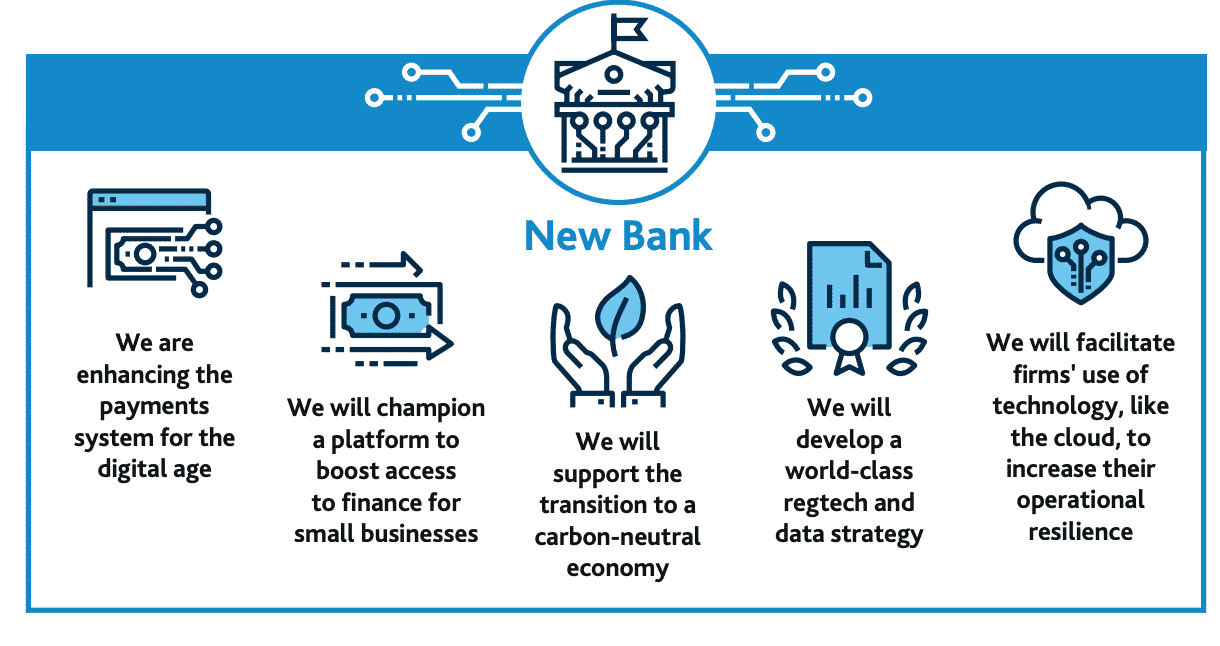 Infographic from Bank of England report
In sum, the central banks of the world have revealed that they are 100% complicit with the United Nations’ economic system known as Sustainable Development, aka Technocracy; the Bank for International Settlements has been recognized by a major financial publication as a “bastion of global technocracy”; and individual central banks are reinventing themselves to complete the transition to the new economic system.
Technocracy is upon the world. It is not driven by citizens, but rather by the same global elitists who have been pushing for it for several decades. As such, it is a huckster operation designed to ultimately twist the natural resources of the world out of the hands of citizens and nations, and into the coffers of the elitists.
I hope the reader can see that the clear and present danger to the world is Technocracy, not Communism, Socialism or Fascism. This must be recognized now, while there is still a sliver of time left to do anything to stop it.
(**For a detailed explanation of Fintech, please see Technocracy: The Hard Road to World Order, Chapter 8, Fintech: Crypto, Cashless and Green.)
Day 9: Technocracy And Smart Cities
 The concept of “smart growth” was a brilliant marketing strategy that was introduced in the early 1990s as an alternative phrase for Agenda 21. Americans don’t like to be included in “agendas” they did not create or approve, but they instantly warmed up to the idea of being “smart”. After all, who wants to be “dumb”?
The concept of Smart Growth has spawned a plethora of derivatives such as Smart City, smart phone, smart network, smart home, smart streets, smart cars, smart grid, smart appliances, etc. Essentially, the inclusion of “smart” has come to mean anything saturated with technology designed to control the object of its focus.
The concept of “smart growth” was a brilliant marketing strategy that was introduced in the early 1990s as an alternative phrase for Agenda 21. Americans don’t like to be included in “agendas” they did not create or approve, but they instantly warmed up to the idea of being “smart”. After all, who wants to be “dumb”?
The concept of Smart Growth has spawned a plethora of derivatives such as Smart City, smart phone, smart network, smart home, smart streets, smart cars, smart grid, smart appliances, etc. Essentially, the inclusion of “smart” has come to mean anything saturated with technology designed to control the object of its focus.
The Big Tech companies of Silicon Valley and similar tech centers fancy themselves to be urban planners, but that is a misnomer. Traditional urban planners seek to build functional cities that work for people, whereas Smart City planners build functional cities focused on controlling people.
As you will remember from other essays in this series, one main object of Technocracy, aka Sustainable Development, is to transfer resources from the hands and ownership of people and their representative institutions into the hands of a global common trust operated by the global elite. When David Rockefeller founded the Trilateral Commission in 1973 to create a “New International Economic Order”, grabbing resources became the master plan and Sustainable Development, aka Technocracy, became the means to that end.
Cities don’t have physical resources like farming, minerals, timber, etc. Rather, it is the rural areas of the world where such resources are found and developed. So, to prepare for taking over large swaths of rural areas, Technocrats developed two coordinated strategies: First, move people from rural to urban settings and second, keep them there.
The United States contains 2.27 billion acres of land. The federal government owns some 650 million acres, representing over 28% of our total land mass. Most federal land is in the western states, which are rich with natural resources. The U.S. Constitution does not provide for broad federal land ownership, but that has not stopped the government from ever-expanding its portfolio. Apologists for federal ownership use the justification that the American people actually own those acres, but in fact much of the federal property is completely inaccessible to the public.
In China, where Technocracy reigns, land grab policies are more direct. For instance, China unveiled a plan in 2014 to summarily move 250 million farmers off their land by 2026 and into megacities that had already been constructed but sat vacant. The vacated farm land is being combined into giant factory farms to be operated by advanced technology such as agricultural robots and automated tractors. Ostensibly, the farmers who refuse to leave will be helped along with the barrel of a gun.
Once relocated into cities of the government’s choosing, these farmers will fall into a social engineering machine that will continuously surveil them, track them, assign social credit scores to limit their access to privileges, etc. They will never regain enough resources or mobility to leave their assigned cities. In other words, they will be trapped.
Smart City Development
Around the world, there are several Smart City commonalities which can be easily observed in practice and in literature:
- Surveillance. Monitor people using biometric facial scanning, geo-spatial tracking, financial data, social media, etc. A population that is surveilled can be easily controlled.
- Transportation. Force people out of private vehicles into shared public transportation such as scooters, bicycles, buses, light rail, etc. Without private transportation, they are locked into the city and out of the rural area.
- Data. Collect real-time data from the Internet of Everything (IoE). IoE is an expansion of the Internet of Things concept to include people as well.
- Control. Social engineering is always leading the thought process of Smart City development. However, unlike elected political representatives, the social engineers are always self-appointed Technocrats who decide what citizens should or should not do, where citizens should or should not go, with whom citizens should or should not associate with, etc.
All of this fits the original definition of Technocracy, as seen in The Technocrat magazine in 1939:
Technocracy is the science of social engineering, the scientific operation of the entire social mechanism to produce and distribute goods and services to the entire population.
Original Technocrats viewed people as nothing more than resources on the same level as animals and natural resources on the planet. Their goal was – and still is – to apply “science” to the efficient balancing of resources by controlling production of goods and services as well as their consumption. The objects of this social engineering would have no more control over their own lives than the cattle in a feedlot.
Smart Cities and Regionalization
In the United States, Smart City policies are increasingly being imposed by regionalization.
The National Association of Regional Councils (NARC) is a non-governmental organization that “serves as the national voice for regions by advocating for regional cooperation as the most effective way to address a variety of community planning and development opportunities and issues.” According to its website, there are over 500 regional councils in all 50 states serving population areas ranging from less than 50,000 to more than 19 million.
These regional entities, known as Councils of Governments (COGs) or Metropolitan Planning Organizations (MPOs), impose Sustainable Development policies on all targeted communities, cities and counties within their supposed jurisdiction, bypassing the officially elected representatives. The NARC literature is very clear regarding its purpose. NARC supports:
- Federal consultation of local governments in formulating environment, energy and land use policies
- community resilience planning to mitigate the impacts of extreme weather events
- expand[ing] Federal incentives to reduce energy dependence and promote renewable energy use
- multi-jurisdictional solutions to reduce greenhouse gas emissions
- empowering regions to utilize the opportunities created by technology and data, included automated and connected vehicles
- public and private investments that provide regions with the tools they need to create economically vibrant and sustainable communities.
In 2019, a new regionalization scheme was launched in Arizona called the Smart Region Initiative (SRI). It will create implementation policies for Smart City technology throughout a given region of cities and counties. As I wrote in February 2019,
The Phoenix area Smart Region Initiative is a pilot program to see how much sovereignty can be stripped from member cities without a mass uprising by disenfranchised citizens. With no elected officials, SRI seeks domination over 22 cities and 4.2 million people to dictate uniform implementation of Smart City policies and technology.
If this pilot is successful, it will be rolled out across the nation for the rapid installation of Smart City tech, including 5G small cell towers, smart street lights with cameras, sensors, and listening devices, smart street technology for autonomous vehicles, data collection technology, and so on.
Conclusion
Where I grew up on a farm in northern California, crops like tomatoes and melons required lots manual labor to pick the fruit during the harvest season. Thousands of workers from Mexico would be granted “green cards” to temporarily enter the U.S. and then would return to their own country when the work was done.
While they moved from farm to farm, they would be housed in dormitory-style facilities known as “labor camps”. These allowed for sleeping and eating, and some facilities were barely better than tents, but the work got done and the workers returned home with their paychecks in hand.
I am reminded of these work camps when I look at today’s modern concept of the Smart City, where captive labor resources are plentiful, accessible and trainable. Is this really the purpose of city life in the 21st century? It would appear so.
For urban dwellers, what happened to all the physical resources throughout the vast expanse of rural America? Well, that’s none of your business anymore. After all, you are “smart” now.
Day 10: Technocracy And Education

Technocrats have long since hijacked the American education system for their own agenda. What once was a system of actual education of students has now become a system intended to produce nothing more than conditioned Technocrat workers. When this is understood, modern education programs – President George Bush’s “No Child Left Behind” policy and President Barack Obama’s Common Core Education Standards and the Trump Administration signing a UN agreement that states “We commit to facilitating the internationalization of education” – will become crystal clear.
When the Technocracy Study Course was written in 1934 by M. King Hubbert and Howard Scott, it was literally intended to be the “bible” of Technocracy. It contained all of the basic elements of societal construction along with rules and principles for living.
Hubbert and Scott names education as one of the pillar service sectors of Technocracy was education. On page 232, they listed “The end products attained by a high-energy social mechanism on the North American Continent” as:
- a high physical standard of living,
- a high standard of public health,
- a minimum of unnecessary labor,
- a minimum of wastage of nonreplaceable resources,
- an educational system to train the entire younger generation indiscriminately as regards all considerations other than inherent ability—a Continental system of human conditioning. (emphasis added)
William Akin elaborated on this in his book, Technocracy and the American Dream (1978, p. 142).
A continental system of human conditioning will have to be installed to replace the existing insufficient educational methods and institutions. This continental system of general education will have to be organized as to provide the fullest possible conditioning and physical training… It must educate and train the student public so as to obtain the highest possible percentage of proficient functional capacity.
Since the basic need of society was technical expertise, their education system would abolish the liberal arts, which addressed outmoded moralistic solutions to human problems. It would essentially replace the humanities with the machine shop. In the process, members of society would be conditioned to think in terms of engineering rationality and efficiency. Man, in short, would then be conditioned to assume the character of machines, to accept “a reality understood in terms of machine-like function.”
Early Technocrats, thoroughly captivated by the vain religion of Scientism, believed that truth about man and the universe could only be discovered through science. As a result, the pioneer of behavioral psychology, B.F. Skinner, was a principal contributor to Technocrat understanding of human conditioning. It was a theory that they eagerly embraced and applied to their utopian model of Technocracy.
Skinner’s association with the Technocracy movement has been well documented in academic literature. Alexandra Rutherford, for instance, wrote B. F. Skinner and Technology’s Nation: Technocracy, Social Engineering, and the Good Life in 20th-Century America in the History of Psychology, in which she stated,
Skinner’s efforts were part of a much larger social engineering tradition that received one of its fullest expressions in the Technocracy Movement of the 1930s.
The balance of Rutherford’s paper detailed the “several philosophical and structural similarities between the Technocrats’ and Skinner’s social visions.”
The Technocracy Study Course is thoroughly dependent on this line of thinking, and every chapter stresses the importance of and need for “conditioning” of all members of society in order for Utopia to materialize. Of course, this goes well beyond just education, but early conditioning of young students was of paramount importance:
No conditioned response to a given stimulus can ever occur unless the subject has previously been through the conditioning experience involving this stimulus and the corresponding response. (p. 187)
- a high physical standard of living,
- a high standard of public health,
- a minimum of unnecessary labor,
- a minimum of wastage of nonreplaceable resources,
- an educational system to train the entire younger generation indiscriminately as regards all considerations other than inherent ability—a Continental system of human conditioning. (emphasis added)
Early Technocrats, thoroughly captivated by the vain religion of Scientism, believed that truth about man and the universe could only be discovered through science. As a result, the pioneer of behavioral psychology, B.F. Skinner, was a principal contributor to Technocrat understanding of human conditioning. It was a theory that they eagerly embraced and applied to their utopian model of Technocracy.
Skinner’s association with the Technocracy movement has been well documented in academic literature. Alexandra Rutherford, for instance, wrote B. F. Skinner and Technology’s Nation: Technocracy, Social Engineering, and the Good Life in 20th-Century America in the History of Psychology, in which she stated,
Skinner’s efforts were part of a much larger social engineering tradition that received one of its fullest expressions in the Technocracy Movement of the 1930s.
The balance of Rutherford’s paper detailed the “several philosophical and structural similarities between the Technocrats’ and Skinner’s social visions.”
The Technocracy Study Course is thoroughly dependent on this line of thinking, and every chapter stresses the importance of and need for “conditioning” of all members of society in order for Utopia to materialize. Of course, this goes well beyond just education, but early conditioning of young students was of paramount importance:
No conditioned response to a given stimulus can ever occur unless the subject has previously been through the conditioning experience involving this stimulus and the corresponding response. (p. 187)
Enter Common Core Education Standards
Although the modern drift of education toward Technocratic conditioning started in the early 1980s, it is not the purpose of this paper to present details that others have presented over the years. Rather, I will skip forward to the latest program called the Common Core Education Standards Initiative (CCESI) which has swept the American education system over the last 10 years.
CCESI was sponsored by the National Governors Association (NGA) and the Council of Chief State School Officers (CCSSO), both of which are non-governmental organizations. CCSSO is a progressive advocacy organization that focuses on “education workforce; information systems and research; next generation learners; and standards, assessment, and accountability.”The NGA’s membership is exclusively the Governors of each state and territory, but it presents itself as a political organization.
It is important to note that both the NGA and CCSSO are completely independent of any government authority or accountability.
Did funding for CCESI come from the federal government? No! Instead, the primary financier was the Bill and Melinda Gates Foundation, controlled by Microsoft pioneer Bill Gates – a Technocrat. In fact, over a 10 year period, Gates provided almost $500 million to various organizations to develop the curriculum according to his own personal vision of education.
Furthermore, according to its own website, the resulting copyright for CCESI is tightly held by these same organizations:
NGA Center/CCSSO shall be acknowledged as the sole owners and developers of the Common Core State Standards, and no claims to the contrary shall be made.
Parents today wonder why the nature and focus of education has changed so radically over the last 10 years. The simple reason is that it has been hijacked by private Technocrat-oriented organizations and funded by Technocrats like Bill Gates. To call this a monumental coup would be an understatement.
Of course, the Technocrats had help and full cooperation from the federal government which had distributed Common Core to the individual states, -proof of how deep the Technocrat influence runs within our political structures.
In sum, Akin’s observation of Technocracy’s “Continental system of human conditioning” has proven correct: “It would essentially replace the humanities with the machine shop.”
Although the modern drift of education toward Technocratic conditioning started in the early 1980s, it is not the purpose of this paper to present details that others have presented over the years. Rather, I will skip forward to the latest program called the Common Core Education Standards Initiative (CCESI) which has swept the American education system over the last 10 years.
CCESI was sponsored by the National Governors Association (NGA) and the Council of Chief State School Officers (CCSSO), both of which are non-governmental organizations. CCSSO is a progressive advocacy organization that focuses on “education workforce; information systems and research; next generation learners; and standards, assessment, and accountability.”The NGA’s membership is exclusively the Governors of each state and territory, but it presents itself as a political organization.
It is important to note that both the NGA and CCSSO are completely independent of any government authority or accountability.
Did funding for CCESI come from the federal government? No! Instead, the primary financier was the Bill and Melinda Gates Foundation, controlled by Microsoft pioneer Bill Gates – a Technocrat. In fact, over a 10 year period, Gates provided almost $500 million to various organizations to develop the curriculum according to his own personal vision of education.
Furthermore, according to its own website, the resulting copyright for CCESI is tightly held by these same organizations:
NGA Center/CCSSO shall be acknowledged as the sole owners and developers of the Common Core State Standards, and no claims to the contrary shall be made.
Parents today wonder why the nature and focus of education has changed so radically over the last 10 years. The simple reason is that it has been hijacked by private Technocrat-oriented organizations and funded by Technocrats like Bill Gates. To call this a monumental coup would be an understatement.
Of course, the Technocrats had help and full cooperation from the federal government which had distributed Common Core to the individual states, -proof of how deep the Technocrat influence runs within our political structures.
In sum, Akin’s observation of Technocracy’s “Continental system of human conditioning” has proven correct: “It would essentially replace the humanities with the machine shop.”
Day 11: Technocracy And The Rise Of Techno-populism
 If you want to start an argument in a room full of political scientists, just ask what they think about Populism. This is a vague term that means something to everyone and nothing to no one.
In the simplest sense, Populism is a movement of ordinary citizens against the elite whom they perceive are wrongly ruling over them. The problem is that it doesn’t matter if the movement is left, right or centrist.
President Donald Trump is said to be riding the wave of Populism because he is perceived to be against the so-called “Deep State” of elites who have a stranglehold on the U.S. political system.
The recently deposed communist leader of Bolivia, Evo Morales, was said to have led a populist movement when he originally rose to power. Alas, things changed when a new and more right-leaning populist movement rose up to throw him out.
The sobering reality about all populist movements is that none of them actually know how to run a country. They know what they don’t like but they have no practical policies that would fix things. Often, a populist group will focus on a single issue or narrow group of issues that have become important to it for any number of reasons, but when they are asked about broader policies to run the entire nation, the discussion falls apart.
If you want to start an argument in a room full of political scientists, just ask what they think about Populism. This is a vague term that means something to everyone and nothing to no one.
In the simplest sense, Populism is a movement of ordinary citizens against the elite whom they perceive are wrongly ruling over them. The problem is that it doesn’t matter if the movement is left, right or centrist.
President Donald Trump is said to be riding the wave of Populism because he is perceived to be against the so-called “Deep State” of elites who have a stranglehold on the U.S. political system.
The recently deposed communist leader of Bolivia, Evo Morales, was said to have led a populist movement when he originally rose to power. Alas, things changed when a new and more right-leaning populist movement rose up to throw him out.
The sobering reality about all populist movements is that none of them actually know how to run a country. They know what they don’t like but they have no practical policies that would fix things. Often, a populist group will focus on a single issue or narrow group of issues that have become important to it for any number of reasons, but when they are asked about broader policies to run the entire nation, the discussion falls apart.
If you want to start an argument in a room full of political scientists, just ask what they think about Populism. This is a vague term that means something to everyone and nothing to no one.
In the simplest sense, Populism is a movement of ordinary citizens against the elite whom they perceive are wrongly ruling over them. The problem is that it doesn’t matter if the movement is left, right or centrist.
President Donald Trump is said to be riding the wave of Populism because he is perceived to be against the so-called “Deep State” of elites who have a stranglehold on the U.S. political system.
The recently deposed communist leader of Bolivia, Evo Morales, was said to have led a populist movement when he originally rose to power. Alas, things changed when a new and more right-leaning populist movement rose up to throw him out.
The sobering reality about all populist movements is that none of them actually know how to run a country. They know what they don’t like but they have no practical policies that would fix things. Often, a populist group will focus on a single issue or narrow group of issues that have become important to it for any number of reasons, but when they are asked about broader policies to run the entire nation, the discussion falls apart.
The Technocrat Appeal
Typically, Technocrats are viewed as polar opposite to populists, and for good reason. Technocrats are often unelected and unaccountable for their actions, and they make important decisions without any connection to the will of the people.
Nevertheless, Technocrats know how to get things done and make things work. This is the exact point where populists and Technocrats find common ground, giving rise to a new term called “Techno-populism”, or a blending of Populism with Technocracy.
Techno-populism has a broad meaning, as does Populism. Even Wikipedia notes that “[t]he diverse range of movements along the political spectrum indicates that techno-populism can be used as a tool by any ideology that presents itself as a party for the people.” The modern use of the term was popularized just after the 2008 financial meltdown.
Dubbing this trend Techno-populism is very accurate because it describes much of what is happening in the Western world today. President Trump was elected on a populist surge but promotes Technocrats to actually make things run. The military, for instance, is full of Technocrats who prosecute armed conflicts. The Internet of Things and 5G are being promoted from the top down. Technocrat influence is likewise seen in the departments of Energy, Transportation, Homeland Security, Environmental Protection and Education. In fact, it was data-minded Technocrats who manipulated both social and traditional media to make the election possible in the first place.
In Europe, three instances of Techno-populism have been identified by political scientists: the Five Star Movement in Italy, Podemos in Spain, and the Pirate Party in Iceland. England’s BREXIT movement is very close to such a declaration.
Even the elitist London School of Economics blog recognizes Techno-populism:
The Five Star Movement and Lega’s nomination of Italian law professor Giuseppe Conte as the next Prime Minister of Italy presents a puzzle: why would an apparently ‘populist’ government nominate a Prime Minister who fits the mould of a technocrat? Chris Bickerton writes that given the Five Star Movement’s history, we should not be surprised at the nomination of Conte. The party stands for a curious blend of technocracy and populism, and is representative of a new type of ‘techno-populist’ party that is emerging elsewhere across Europe.
When Franklin Delano Roosevelt was seated as President in 1933, he was challenged by the early Technocrat leaders to declare himself dictator in order to implement Technocracy. He refused the “offer” but had no problem admitting scores of Technocrats into his administration to run the country.
In Nazi Germany, Hitler outlawed the Technocracy, Inc. movement because he could tolerate no competition, but then he relied heavily upon Technocrats to build his Fourth Reich.
At the end of WWII, President Truman authorized top-secret Operation Paperclip to bring some 1,600 Technocrat scientists and engineers from Nazi Germany to America and place them in top positions within our own government. Of special note were rocket scientists and aerospace engineers.
The only valid observation here is that Technocrats are always in demand by political leaders, who have no reservation about using them to further political objectives. Political administrations come and go, but the underlying Technocrats continue on uninterrupted.
In today’s world, the curious attraction between Populists and Technocrats is akin to a moth being attracted to the flame: Populists cannot prevent being ultimately dominated and burned by Technocrats.
Typically, Technocrats are viewed as polar opposite to populists, and for good reason. Technocrats are often unelected and unaccountable for their actions, and they make important decisions without any connection to the will of the people.
Nevertheless, Technocrats know how to get things done and make things work. This is the exact point where populists and Technocrats find common ground, giving rise to a new term called “Techno-populism”, or a blending of Populism with Technocracy.
Techno-populism has a broad meaning, as does Populism. Even Wikipedia notes that “[t]he diverse range of movements along the political spectrum indicates that techno-populism can be used as a tool by any ideology that presents itself as a party for the people.” The modern use of the term was popularized just after the 2008 financial meltdown.
Dubbing this trend Techno-populism is very accurate because it describes much of what is happening in the Western world today. President Trump was elected on a populist surge but promotes Technocrats to actually make things run. The military, for instance, is full of Technocrats who prosecute armed conflicts. The Internet of Things and 5G are being promoted from the top down. Technocrat influence is likewise seen in the departments of Energy, Transportation, Homeland Security, Environmental Protection and Education. In fact, it was data-minded Technocrats who manipulated both social and traditional media to make the election possible in the first place.
In Europe, three instances of Techno-populism have been identified by political scientists: the Five Star Movement in Italy, Podemos in Spain, and the Pirate Party in Iceland. England’s BREXIT movement is very close to such a declaration.
Even the elitist London School of Economics blog recognizes Techno-populism:
The Five Star Movement and Lega’s nomination of Italian law professor Giuseppe Conte as the next Prime Minister of Italy presents a puzzle: why would an apparently ‘populist’ government nominate a Prime Minister who fits the mould of a technocrat? Chris Bickerton writes that given the Five Star Movement’s history, we should not be surprised at the nomination of Conte. The party stands for a curious blend of technocracy and populism, and is representative of a new type of ‘techno-populist’ party that is emerging elsewhere across Europe.
When Franklin Delano Roosevelt was seated as President in 1933, he was challenged by the early Technocrat leaders to declare himself dictator in order to implement Technocracy. He refused the “offer” but had no problem admitting scores of Technocrats into his administration to run the country.
In Nazi Germany, Hitler outlawed the Technocracy, Inc. movement because he could tolerate no competition, but then he relied heavily upon Technocrats to build his Fourth Reich.
At the end of WWII, President Truman authorized top-secret Operation Paperclip to bring some 1,600 Technocrat scientists and engineers from Nazi Germany to America and place them in top positions within our own government. Of special note were rocket scientists and aerospace engineers.
The only valid observation here is that Technocrats are always in demand by political leaders, who have no reservation about using them to further political objectives. Political administrations come and go, but the underlying Technocrats continue on uninterrupted.
In today’s world, the curious attraction between Populists and Technocrats is akin to a moth being attracted to the flame: Populists cannot prevent being ultimately dominated and burned by Technocrats.
Day 12: Rejecting Technocracy

Having just written eleven essays showing how Technocracy is a malignant cancer growing at breakneck speed all around the world, and especially in the United States, I will not sugar coat either the problem or the solution.
Four years ago, I wrote my first book on Technocracy, Technocracy Rising: The Trojan Horse of Global Transformation. I purposely used the term “Trojan Horse” to express that this has been a well-disguised sneak attack from the very beginning.
Today, the trap door is open and the attackers are pouring out. They are in plain view, working their craft to ensnare us into a Scientific Dictatorship.
Yet, Americans continue in oblivion, distracted by every imaginable political sideshow that has no substance, and entertained by a constant parade of bread and circuses.
Our epitaph could well read, “America: Alas, She Died In Her Sleep”.
In the meantime, there are thousands of Americans diligently defending their local communities from the various tentacles of Technocracy: Smart Grid, property rights abuses, 5G rollout, government mandated vaccinations, surveillance cameras, global warming and so many more.
To have any significant impact to actually STOP Technocracy, this force needs to replicate itself at scale and with great speed.
It is essential to understand that the national government will not and cannot save your local community, city or county. Washington is already swimming with Technocrats who are using the Federal apparatus to promote Technocracy throughout America. The last and only line of defense is in your local cities, towns an counties. This successful strategy has been proven time and time again, and it works.
Target The Achilles Heel
In Day 6: Technocracy’s Necessary Requirements, I listed the original items that need to be in place for Technocracy to take hold. These requirements were clearly stated in the Technocracy Study Course and they are just as valid today as they were in 1934.
To the extent that we can block or scramble any of those requirements, we can deal a serious blow to advancement of Technocracy and Technocrats. Thus, it is imperative to focus on these things:
- Smart Grid, Smart Meters, Alternative Energy – There is no doubt that the national power grid needs to be updated, but not in a way that seeks to control energy. There is no energy shortage and there is no demonstrated need for “alternative energy”. Stop those plans. Expose them. Educate your local officials to not fall prey to the false narrative that the world will end in 12 years if they don’t take action. Demand that your local and elected officials personally write all city and county ordinances and block outside lobbyists from having any foothold.
- 5G rollout and Internet of Things – If Technocrats fully implement 5G, artificial intelligence programs will take over the Internet of Things. By stoping 5G Small Cell antennas from being erected in your community, you could deal a fatal blow to near-term plans for Technocracy.
- Surveillance cameras, license plate readers, militarization of police – Again, these are local issues that can only be addressed locally. Demand that your local leaders re-cast your law enforcement as peace keepers instead of military wannabes. Do not trade security for privacy.
- Demand data privacy – Your local officials can create and pass binding resolutions that literally tie technocrats in knots when they are denied free access to your data. Your city exists to protect the rights of its citizens; make them work at it!
- Reject regionalization – Most UN policies for Agenda 21 and Sustainable Development, aka Technocracy, are imposed through regional governance entities called Councils of Governments. These are organizations are patently unconstitutional and you should demand that your city, town and county withdraw from and reject all such regionalization.
- Education reform in your local schools – Any and all outside influence over education and curricula must be rejected, with control being returned to parents and local teachers. If they refuse, encourage everyone in your community to get their children out of government schools and into private or home school situations. As documented in Day 10: Technocracy and Education, human conditioning promoted by Technocracy is toxic and NOT eduction.
This is not an exclusive list, and I will reserve the right to edit or add to this article in the future. However, I hope you get the idea that you have the power in your hands to make immense changes in your local community that will stop Technocracy and Technocrats dead in their tracks.
Turn off the TV. Quit wasting time shaking your fist at Washington theatrics. Get up. Get out. Meet people where you live, shop, raise children, etc. Make a difference. Sure, you may get some resistance, but I can virtually guarantee that you will be shocked by the numbers of fellow citizens who are thinking the same as you are.
Despite our efforts to the contrary, it is possible and perhaps even probable, that Technocracy will win and throw us into a Scientific Dictatorship from which there is no escape. On the other hand, Americans have overcome seemingly insurmountable enemies in our past, but only to the extent that we came together as AMERICA and threw off the forces that sought to bury us.
Where do you stand?


Comments
Post a Comment