The Twelve Days of Technocracy Part 1
Day 1: We Were Warned About Technocracy
After having written two books on Technocracy, reviewed over 230 important historical books and posted almost 4,000 related stories, there is a tendency to think that the subject is exhausted.
But, it is not.
Almost every day some new thing pops up that surprises me, whether from industry, academia or government. Historical tidbits constantly surface that show how analysts foresaw our current trajectory decades earlier. Modern scholars often write openly about Technocracy and Technocrats, especially in Europe or Asia, and yet America largely remains in the dark.
As I present my findings in public forums, whether speaking or writing, I am constantly aware of some kind of invisible wall that keeps the message from being fully understood or propagated. For instance, I have sent dozens of review copies of books to key centers of influence around the country, but how many reviews have actually been published? Hardly any. I have presented to elected officials, attorneys, civic leaders and scientists. How many have embraced any understanding of Technocracy? Again, hardly any.
However, for all the people who have confirmed their understanding and alarm of Technocracy, I am fully convinced that the material is easy enough to understand for anyone who is willing to understand it. Apparently, most are not willing. In some cases, people are too distracted with other things to pay attention. In other cases, people turn a blind eye because they find themselves profiting off some aspect of Technocracy and don’t want to upset their own applecart.
Whatever the case, America is largely missing the many siren calls for radical change in America. Here is a case in point.
Dr. Parag Khanna, a leading global scholar promoting Technocracy, speaks to elite groups all around the world. With bachelor’s and master’s degrees from the School of Foreign Service at Georgetown University and a PhD from the London School of Economics, Khanna has written several highly esteemed books on various aspects of globalization.
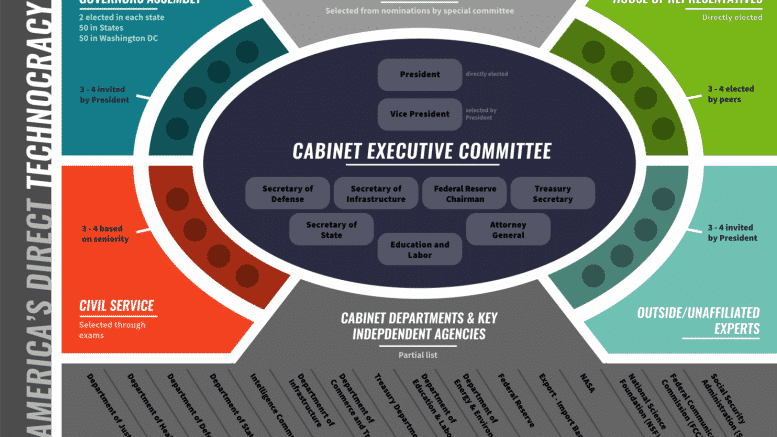
In 2017, Khanna released a book with the very pointed title Technocracy in America: Rise of the Info-State. Endorsed by many prominent globalists, it laid out the radical agenda of what a “direct Technocracy” would look like in America:
In America, direct technocracy would look like this: A collective presidency of about a half-dozen committee members backed by a strong civil service better able to juggle complex challenges; a multi-party legislature better reflective of the diversity of political views and using data technologies for real-time citizen consultation, and the Senate replaced by a Governors Assembly that prioritizes the common needs of states and shares successful policies across them; and a judicial branch that monitors international benchmarks and standards, and proposes constitutional amendments to keep pace with our rapidly changing times.
How would we get to a direct Technocracy? Khanna states that “it is time again for a new constitutional convention” and concludes that “only utilitarian thinking can bring about another progressive era.”
Of course, Americans can ignore Khanna, but the global elite don’t, because he is writing to their long-established goals of doing exactly what he proposes! Abolish the Senate and give the Constitution to the Supreme Court? Have a committee of Presidents? Adopt utilitarian thinking to promote progressivism?
This is not Marxism, Socialism or Communism. It is Technocracy. Everything else going on around us is a sideshow that provides nothing more than a convenient cover for those behind the curtain who are the real movers and shakers in the world.
Day 2: Academic Backing Of Technocracy

Dr. Francis Schaeffer was an historian, Christian philosopher and one of the greatest thinkers of the last century. In Episode X (the final segment) of his video series, How Should We Then Live?, he stated that society was falling into a moral abyss with no fixed absolutes to provide form and structure for living. To replace that necessary structure and thereby avoid utter societal chaos, he accurately and clearly recognized that such absolutes would be supplied by an increasingly authoritarian, technocratic elite. (Yes, Schaeffer actually used the word “technocratic”.)
In other words, as people lost the ability to self-regulate their own life and behavior, someone or something would step into the vacuum and do it for them.
A younger contemporary of Schaeffer was Zbigniew Brzezinski, who wrote Between Two Ages: America’s Role in the Technetronic Era when he was a political science professor at Columbia University in the late 1960s. Brzezinski was the polar opposite of Schaeffer in that he eschewed Christianity, Christian philosophy and even the existence of God.
Brzezinski came to virtually the same conclusion as Schaeffer (for entirely different reasons) when he wrote,
Such a society would be dominated by an elite whose claim to political power would rest on allegedly superior scientific know-how. Unhindered by the restraints of traditional liberal values, this elite would not hesitate to achieve its political ends by using the latest modern techniques for influencing public behavior and keeping society under close surveillance and control. Under such circumstances, the scientific and technological momentum of the country would not be reversed but would actually feed on the situation it exploits. (emphasis added)
Brzezinski further stated,
Persisting social crisis, the emergence of a charismatic personality, and the exploitation of mass media to obtain public confidence would be the stepping stones in the piecemeal transformation of the United States into a highly controlled society. (emphasis added)
Since Schaeffer was an avid reader, he likely had read Brzezinski’s work, but I can find no proof of that. He did, however, read Daniel Bell’s seminal 1973 book, The Coming of Post-Industrial Society: A Venture in Social Forecasting.
Bell had received his PhD in sociology from Columbia University in 1961. We know he was well acquainted with Brzezinski’s work because he thoroughly critiqued it in his own book.
There are two reasons that I bring up Bell: first, he was a self-professed apologist for Technocracy and second, Schaeffer held up Bell’s book toward the end of Episode X and quoted from page 480:
The lack of a rooted moral belief system is the cultural contradiction of the society, the deepest challenge to its survival.
Bell was indeed a big thinker in the same vein as Brzezinski; both were Technocrats and both were educated at Columbia University where Technocracy was originally conceived in 1932. Bell, however, was much more direct than Brzezinski when he wrote,
The technocratic mode has become established because it is the mode of efficiency – of production, of program, of “getting things done.” For these reasons, the technocratic mode is bound to spread in our society. (p. 354)
It was Bell who first popularized and developed the concept of the “post-industrial” society:
Since the post-industrial society increases the importance of the technical component of knowledge, it forces the hierophants of the new society – the scientists, engineers and technocrats – either to compete with politicians or become their allies.
Bell’s 489-page “essay in social forecasting” presented the big picture of the future. It was ominously written in the same year (1973) that the Trilateral Commission was co-founded by Brzezinski and David Rockefeller.
Now, I had already cited Bell’s works in both of my books on Technocracy, but I had fallen short in examining who or what might have stimulated Bell to write his book in the first place. This became my 2019 surprise as I picked up my own copy of Bell’s The Coming of Post-Industrial Society (the same edition that Schaeffer referenced above) and read it’s Preface more carefully:
My greatest debt, institutionally, is to the Russell Sage Foundation and its president, Orville Brim. A grant from the foundation in 1967 at first released me from one-third of my teaching schedule at Columbia, and allowed me to organize an experimental graduate seminar at Columbia on modes of forecasting. The foundation also subsidized my research in the next few years. In 1969-1970 I spent a sabbatical year as a visiting fellow at the foundation, where this book began to take shape. (emphasis added)
Essentially, Bell was employed by the Russell Sage Foundation as he fleshed out his book.
The Russell Sage Foundation, launched in 1907, is one of the oldest foundations in America. It started as an ultra-progressive champion of “social sciences” and has been continuously connected to the most progressive elements of the global elite ever since. Its website currently states,
The Russell Sage Foundation is the principal American Foundation devoted exclusively to research in the social sciences. Currently, the Foundation dedicates itself exclusively to strengthening the methods, data, and theoretical core of the social sciences as a means of improving social policies.
Not surprisingly, the historical archives of the Russell Sage Foundation are housed at the Rockefeller Archive Center in New York.
The academic support for modern Technocracy is obvious and easily traced. The literature is pointed and definitive: they all envisaged a technocratic elite rising to dominate populations.
Given this vision, it is no surprise that the Trilateral Commission sprang forth in 1973 to “make it so” – with “Captain Brzezinski” at the helm as its first Executive Director.
Day 3: Technocracy In Europe And America
Once upon a time, Jean Meynaud (1914-1972) was a professor of Political Science at the University of Paris and widely known as a leading political scientist in Europe. His works are still recognized as foundational in modern Europe, but you would be hard-pressed to find any American who ever heard his name.
In 1964, Professor Meynaud wrote a seminal book with the simple title of Technocracy. Indeed, Europe was not ignorant of the changes taking place that rankled institutions as well as the people they represented, and there was no love lost for unelected and unaccountable technocrats who were usurping power. At the time in France, this topic was even on the lips of political protestors who cried “Down with Technocracy”.
Meynaud noted that “the fundamental basis of technocracy is a faith in an efficiency so great that maximum results are obtained by minimum effort.” He wrote,
Let us suppose that in a world in which the profit motive becomes more and more paramount, the political authorities (as is already partly true) failed to keep a close watch on the activities of technologists, who do not all have the public interest at heart; in the end, the effect would be a barely perceptible evolution towards a regime which would be democratic only on the surface. The elected representatives would be deprived of the substance of their power… The democratic principle would then be nothing more than the ‘front’ (as skeptics say it has always been) behind which the true leaders of the country would justify or disguise their domination.
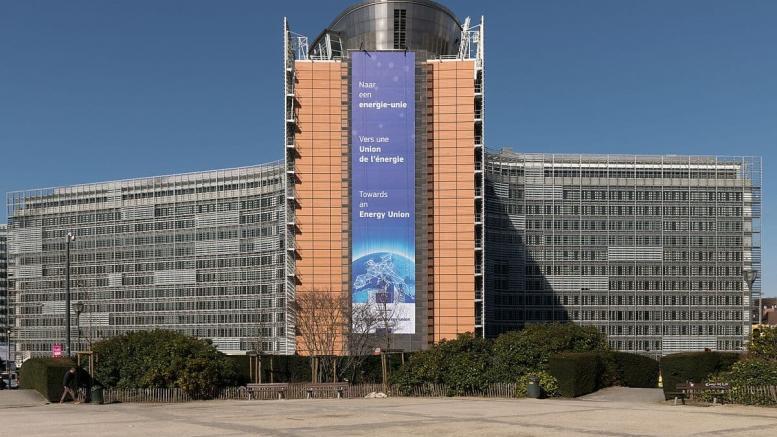
In the intervening years from 1964 to 2019, Europe has continued this trend, transforming itself into a full-blown Technocracy controlled by unelected and unaccountable European Union Technocrats. Europeans widely recognize this today, laying their angst at the levers of the technocrat machine that dominates every single area of their lives.
Having entrenched themselves into an unmovable power structure, these Technocrats are now killing off democracy, free enterprise and capitalism in order to implement the economic system of Technocracy known as Sustainable Development or the Green Economy. This is a resource-based economic system, unlike the free market of supply and demand, where both production and consumption are controlled by a single entity – namely, those same Technocrats.
Knowing that mass resistance (after all, people were already crying “Down with technocracy”) would accompany the economic transition, anthropogenic global warming (AGW) was introduced as a fear mechanism to drive citizens into not only accepting, but demanding the one-and-only solution offered: Sustainable Development, aka Technocracy.
As his book clearly shows, Meynaud really understood what was about to take place. Technocratic encroachment would eventually dominate the political structure, while leaving its outward appearance in place to placate citizens into thinking nothing had really changed. Meynaud nails this:
I use the term ‘influence’ broadly, meaning the capacity possessed by some people to induce others to act, think and feel in a certain way or according to a predetermined suggestion. This aptitude enables technocrats to grasp a certain measure of authority over the politicians who are directly or indirectly chosen by the people to assume control of public affairs. This allows them to guide the lines of action which politicians adopt and the decisions they take.
This is Social Engineering on the grandest scale. It is the tail that wags the dog. It is the wizard behind the curtain who pulls the levers.
Has this happened in America? Does anyone really think that our elected representatives in Congress have any substantive power to make key decisions that favor the people instead of other institutional interests? Is the Administration effective at turning back the growing infrastructure of Technocracy? Of course not! Technocrats are seen continuously asserting themselves: Big Pharma, Big Tech, Big Banks, etc.
Furthermore, Meynaud nailed the societal impact of this Technocrat encroachment:
In a representative democratic system, the power of suffrage and the trust of the people tend to be eroded by the advance of technologists. (emphasis added)
In today’s America, lack of trust is a scourge nobody saw coming. Nobody trusts anyone anymore. Congress is so badly divided that some people are saying it can never be healed again. The hostile divide between government and citizens is at an all-time high. Families are breaking up as children turn against their parents. Employees are turning on their employers.
In short, trust has been destroyed at every level. But don’t think that this just happened by accident; it is a direct outcome of the growth of Technocracy in America.
Thankfully, Meynaud noted that “Technocratic power is not a permanent acquisition.” Of course, he said that in 1964, before Technocracy had fully asserted itself in Europe. How Europeans could throw off Technocracy today is a mystery and a seemingly impossible feat.
In America, we still have a short window of time to do something about it. We can join the earlier calls made in France of “Down with technocracy”. But… we had better be more certain to follow our rhetoric with tangible, concrete and forceful actions to ensure its demise.
In the meantime, spare me the criticism that Technocracy is just a myth and a conspiracy theory. Many great scholars and thinkers have written extensively about it over the decades, and we all are without excuse if we ignore them.
Day 4: Technocracy Vs. Communism/Socialism, Fascism
As individualists for the most part, Conservatives are scared to death of Socialism. As collectivists, Socialists are scared to death of falling short of the ‘common good’. Each group has a unique and strikingly different belief system and supporting logic.
Those who believe that Socialism (or Communism) is the bogeyman just can’t get it out of their head. I have sat down with intelligent people and carefully gone through the following table of comparisons, and they have eagerly nodded their heads in agreement. But the next day they revert right back to talking about the dangers of Socialism and Communism. Were they just not paying attention? Were they being disingenuous and only pretending to agree with me? Probably neither.
The fact is, old habits of thinking and acting are very hard to change. All of us struggle to some degree when we are challenged with new thoughts that require a shift in our existing belief system. If we believe that Socialism or Communism is the biggest enemy of the state, we will be very resistant to any facts to the contrary.
It is true that the trappings of former political systems are still visible in certain countries. China still has the hammer and sickle. Germany still has a few neo-Nazis running around. But how many times have we ever been told, “Don’t judge a book by its cover”? Times change. Things change. Our thinking about them must advance as well. Holding a world view from 10, 20 or 30 years ago is simply not adequate today.
With that said, I was hoping hope to change readers’ mindsets when I wrote in Technocracy Rising: The Trojan Horse of Global Transformation, “The dark horse of the New World Order is not Communism, Socialism or Fascism: It is Technocracy.”
The ancient Chinese General Sun Tsu, who wrote The Art of War in the 6th century BC, noted that the enemy must be clearly identified before victory can be achieved. This is still true today. Technocrats smile inwardly when you call them Communists, Socialists or Fascists because this allows them to continue on their way unthreatened and uninterrupted.
Here are 25 comparisons that make the proper distinction between Technocracy, Communism/Socialism and Fascism. To correctly cement the features of each ideology into your worldview, I suggest reading and contemplating this list every day for 30 days straight.
| TECHNOCRACY | COMMUNISM/SOCIALISM | FASCISM |
| Endgame: Scientific Dictatorship | Endgame: Classless society | Endgame: National strength |
| Hates Communists, favored Fascists | Hates Fascists & Technocrats | Hates all types of Marxists |
| Has contempt for electoral democracy | Promotes electoral democracy | Has contempt for electoral democracy |
| Seeks totalitarian system by scientific methods | Seeks totalitarian system by communitarianism | Seeks totalitarian system by nationalistic submission |
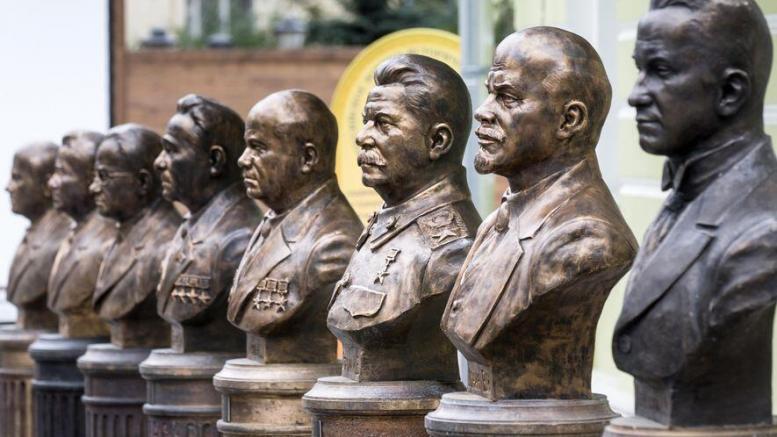
| Relies upon cult of science (Scientism) | Relies upon cult of personality (Stalin, Lenin, Mao, Che) | Relies upon cult of personality (Hitler, Mussolini) |
| Promotes Scientism | Promotes atheism | Promotes a form of Christianity |
| Promotes cities, is anti-rural | Promotes rural development | Anti-urban, promotes rural identity |
| Replaces Capitalism with resource-based economic system | Managed Capitalism | Generally supports Capitalism for its own purposes |
| Despises Capitalism | Marx believed Capitalism was a necessary step to Communism | Viewed as a ‘third way’ between Capitalism and Communism |
| Apolitical | Mostly viewed as ‘left wing’ | Often viewed as ‘conservative’ |
| Racially agnostic | Stalin condemned anti-Semitism | Tends toward anti-Semitism and racism |
| Highly reveres intellectuals who agree with them | Killed intellectuals in their own countries, on multiple occasions | Killed intellectuals in other countries |
| Generally pacifist | Mostly killed their own citizens | Mostly killed citizens of other countries, plus Jews and other ‘undesirables’ |
| Controls people with the system/technology | Controls people with people | Controls people with dictator |
| Population: over-populated | Population: non-issue | Population: non-issue |
| Genetic cleansing, general population reduction | Ideological cleansing | Genetic cleansing, but selective |
| Universal Basic Income (UBI) | Stratified pay structure, according to the need of each citizen | Stratified pay structure, according to merit and value to leadership |
| Advances according to the advancement of technology | Advances according to the development of ideology | Advances according to the strength of the nation |
| Human conditioning to live within the system | Education supports ideology | Education supports nationalism |
| Global citizen, city-state oriented | Nation-state oriented | Nation-state oriented |
| Dissolves the state | Empowers the state | Empowers the state |
| Science knows best | People know best | People know best |
| Social engineers hide behind facade of science | Leadership easily identified | Leadership easily identified |
| “Technocracy is the science of social engineering, the scientific operation of the entire social mechanism to produce and distribute goods and services to the entire population…” (The Technocrat, 1938) Eradicates profit completely and all private property, establishes a resource-based economy controlled by a scientific elite using data-driven scientific method. | Communism: Political and economic doctrine that aims to replace private property and a profit-based economy with public ownership and communal control of at least the major means of production (e.g., mines, mills, and factories) and the natural resources of a society. (Encyclopedia Britannica) | Fascism, a political philosophy, movement, or regime that exalts nation and often race above the individual and that stands for a centralized autocratic government headed by a dictatorial leader, severe economic and social regimentation, and forcible suppression of opposition. (Merriam-Webster) A political regime, having totalitarian aspirations, ideologically based on a relationship between business and the centralized government, business-and-government control of the marketplace, repression of criticism or opposition, a leader cult and exalting the state and/or religion above individual rights. By extension, Any system of strong autocracy or oligarchy usually to the extent of bending and breaking the law, race-baiting and violence against largely unarmed populations. (Wikitionary) |
| ”We are building this global society without a global leader. Global order is no longer something that can be dictated or controlled from the top down. Globalization is itself the order.” Dr. Parag Khanna | Stepping-stone to Technocracy Zbigniew Brzezinski stated in Between Two Ages: America’s Role In the Technetronic Era (1970), that Communism and Socialism were necessary stepping stones to get to the end game, but they were not the end game in themselves. The final stage was to be Brzezinski’s Technetronic Era, which is Technocracy |

Comments
Post a Comment